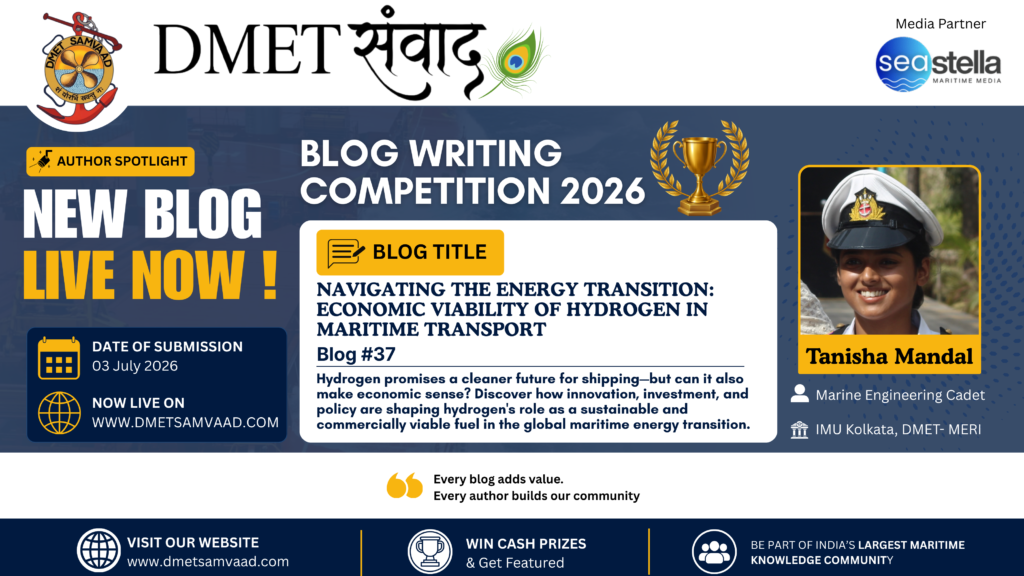
“DECARBONIZING MARITIME TRANSPORT ISN’T JUST ABOUT ENVIRONMENTAL IDEAS; INSTEAD, IT’S ABOUT HARD NUMBERS. WE TOOK A DEEP DIVE INTO THE DATA TO SEE EXACTLY WHAT IT WILL TAKE, FROM STRICT TAXES TO THE PRICE OF BUNKERING VESSELS, TO MAKE HYDROGEN A FINANCIALLY VIABLE FUEL OVER TRADITIONAL HFO.”

- NAVIGATING THE ENERGY TRANSITION: IS HYDROGEN THE FUTURE OF MARITIME TRANSPORT?
Global warming’s major cause is the emission of greenhouse-effect gases (GHG), especially carbon dioxide (CO2) whose main source is the combustion of fossil fuels. Fossil fuels serve as the primary energy source in many industries, including shipping, which is the focus of this study. One of the measures proposed to tackle GHG emissions is the development of green shipping corridors – carbon-free shipping routes that require the transition to alternative fuels, which are gaining competitiveness. One of the reasons for that is carbon pricing, which taxes CO2 emissions. However, the lack of consensus on the most cost-advantageous alternative fuel in the long run results in the delay of the implementation of green shipping corridors. transport has had the highest growth in GHG emissions, growing at an annual average rate of nearly 1,7% from 1990 to 2021 . In the field of transportation, shipping stands out as a critical subsector for global trade since it offers higher energy efficiency , lower cost, larger capacity, and more flexible transportation routes than other subsectors . The volume of cargo carried by sea has generally been increasing over the past years, as shown in Fig. 1, and in 2021, maritime transportation accounted for more than 80% of the global trade volume according to the United Nations .
In order to mitigate GHG emissions derived from shipping, several measures have been implemented. The adoption of the International Convention for the Prevention of Pollution from Ships (MARPOL) by IMO in 1973 was a remarkable milestone towards the prevention of pollution of the marine environment caused by shipping. In May 2005, Annex VI of MARPOL, which covers the prevention of air pollution caused by ships, entered into force
2. THE RISE OF GREEN SHIPPING CORRIDOR
The concept of green corridors in maritime transportation has emerged as a critical strategy for sustainable development and decarbonization in recent years. Green corridor initiatives focus on the holistic decarbonization of the supply chain, taking into consideration all its elements: fuel production, port logistics, bunkering, vessels, cargo, end customers, financing, and legislation. These initiatives encourage collaboration among these stakeholders and give them the resources they need to start their path toward decarbonization.
In 2021, 24 countries signed the Clydebank Declaration at COP26 and committed to encouraging the creation of green shipping corridors, through the promotion of partnerships between stakeholders, the mitigation of challenges through the development of regulations and infrastructure, the sharing of knowledge, and the inclusion of green corridors in National Action Plans . A year after, 40 initiatives for shipping decarbonization were announced in COP27, over half of which involved the subject of green shipping corridors . Even though they are only at the initial stages, advancements in green corridors are progressing rapidly , but still there are challenges that need to be addressed.
The first challenge is the implementation of these initiatives, as there is still limited knowledge on how to turn the theoretical plan of green shipping corridors into practical implementation, as the majority of initiatives are still in the planning phase . To accelerate the actual implementation, the involved parties should share knowledge and solutions .
Another challenge is the definition of the fuel pathway, as many initiatives are not focused on a specific fuel yet. For the accelerated and successful development of the initiatives, it is essential to focus the efforts on a single fuel strategy. However, all corridors will focus on a single fuel strategy but will aim for being able to run on several fuels. At the end of 2022, 41% of green shipping initiatives had not yet decided which fuel to use . Among those who have decided, both ammonia and methanol were the preferred options, as each of them was selected by 16% of the initiatives. Additionally, 9% of the initiatives opted for hydrogen , and another 9% chose advanced biofuels, as incentivized by EU . The last bottleneck to highlight is the availability, price, and regulation regarding alternative fuels, which currently are not as advantageous as traditional fuels .
According to the research, LNG is the most favourable and cost-effective option for the near future but Hydrogen stand out in term of long term sustainable option.
Table 1. Comparative analysis of most advantageous alternative fuels and parameters considered in different studies.
| Most Advantageous Fuel | Parameters Considered in the Analysis and Selection of the Fuel |
| Ammonia | Parameters not revealed in the study |
| Hydrogen | Fuel consumption cost, boil-off gas (BOG) combustion cost, and carbon tax |
| Hydrogen in the long-term LNG in the short-term | Operational cost, fuel cost, capital cost for the propulsion system, and other parameters (safety, reliability of the supply chain, availability of the infrastructure, impact on environment) |
| Hydrogen in the long-term LNG in the short-term | Parameters not revealed in the study |
| Bio-LNG, synthetic LNG, or e-LNG In the long-term LNG in the short-term | Parameters not revealed in the study |
| Ammonia and methanol | Parameters not revealed in the study |
| Ammonia and hydrogen | Parameters not revealed in the study |
| LNG | Parameters not revealed in the study |
| Bio-LNG, synthetic LNG, or e-LNG In the long-term LNG in the short-term | Parameters not revealed |
| Ammonia and hydrogen | Parameters not revealed |
| Ammonia and methanol | Total cost of ownership: fuel production costs, propulsion cost, on-board fuel storage cost and a cost for reduced cargo space |
| Ammonia and methanol | Life cycle costs (capital, maintenance, repair and disposal costs, cost flows of expenses and revenue), other parameters (human toxicity, resource use, water use) |
| Ammonia | Carbon abatement cost, other parameters (human toxicity, freshwater ecotoxicity) |
| Biogas, Dimethyl ether, Ethanol, LNG, Liquefied petroleum gas, Methanol, Ammonia and Biodiesel | Environmental damages during life cycle (human health, ecosystem, resource utilization, emission inventory and social costs) |
| Ammonia, Biodiesel, Dimethyl ether, electro Fischer Tropsch diesel fuel, electro methanol, Fischer Tropsch diesel fuel, Hydrogen, LNG, Liquefied petroleum gas, marine diesel oil, marine gas oil, marine bio-oil, Methanol, pyrolysis oil, renewable diesel, straight vegetable oil and ultra-low sulfur heavy fuel oil | Climate change, acidification, freshwater ecotoxicity, marine eutrophication, terrestrial eutrophication, non-cancer human toxicity, particulate matter and photochemical ozone formation criteria |
| Diesel, Electricity, Methanol, Dimethyl ether, Natural gas, Hydrogen, Biodiesel | Carbon allowance scenarios and other economic parameters |
| LNG, Ammonia, Methanol and other biofuels | Carbon pricing of each fuel and other economic parameters |
| Hydrogen (H2 Polymeric Electrolytic Membrane Fuel Cell and H2 Internal Combustion Engine) | GHG emissions, resource use, toxicity potential, among other environmental issues |
| HFO, Marine gas Oil, Gas-to-Liquid fuel, LNG | Acidification and eutrophication potentials, energy use and global warming potential |
3. WHICH ALTERNATIVE FUEL WINS?
Comparative analysis of fuel alternatives by total cost and fuel selection:
Analyzing the total cost of the different alternative fuels was important for determining which is more cost-effective in this case study. Since the total cost of hydrogen and ammonia depends on the deployment cost of a bunkering vessel per voyage, which is uncertain, the total cost was calculated for different values of the deployment cost. These results have been represented in charts that display the total cost in relation to the deployment cost of a bunkering vessel per voyage.
The charts include the total cost obtained for LNG and methanol in order to determine if there is an intersection point with the curves of ammonia and hydrogen, which denotes the point at which the total cost of ammonia and hydrogen surpasses this value. The coordinates on both charts represent the deployment cost per bunkering vessel per voyage at which the total cost of hydrogen exceeds the total cost of LNG and methanol.
It is possible to conclude that hydrogen is the alternative fuel with the lowest total cost when the deployment cost per bunkering vessel is lower than 1,990,284,78 $ for a sailing speed of 22 knots and 2,190,171,09 $ for a sailing speed of 18 knots. If the deployment cost per bunkering vessel exceeds this value, LNG becomes the most advantageous alternative fuel in terms of cost for both sailing speeds. Furthermore, it is evident that ammonia is the less cost-advantageous fuel option, as the total cost when using this fuel exceeds the cost of using any of the other fuels under study for any value of deployment cost per bunkering vessel per voyage. The cost parameter that contributes the most to this cost discrepancy between ammonia and other fuels is the cost of converting the vessel to transition from HFO to an alternative fuel. This cost is significantly higher for ammonia compared to the others.
5. PARITY IN ECONOMY: MAKING ALTERNATIVE FUEL COST-EFFECTIVE
While heavy fuel oil (HFO) is more economically viable, the transition to green shipping is an environmental necessity. We can close the gap between fossil fuels and sustainable alternatives if industry leans into three drivers: specific ports where green bunkering infrastructure actually exists to support the voyage.
- Taxing carbon emissions: Implementing strict carbon taxes on CO₂ emissions can make shipowners shift towards zero or low-carbon alternatives.
- Managing sailing speed: Fuel pricing is highly interlinked with how the ship is operated. Studies show managing speed can actually make wonders: higher or optimized speeds can actually decrease the cost delta between traditional HFO and greener alternatives.
- Bunkering capacity limitation: the cost-effectiveness if zero emission fuels depends heavily on the deployment cost of bunkering vessels. If bunkering cost is below (roughly $1.99M at 22 knots or $2.19M at 18 knots) then Hydrogen wins.
If the bunkering cost goes above it, Liquified Natural Gas wins.
CONCLUSION
To help the shipping industry cut emissions, this framework empowers stakeholders to compare costs and decide which green fuel is best for their specific needs. Although hydrogen and LNG are the most cost-effective alternatives, traditional fossil fuels, unfortunately, remain cheaper. Ultimately, government funding is essential to make these eco-friendly choices financially viable.