Introduction
International shipping accounts for an estimated 2–3% of global greenhouse gas emissions annually — a share the International Maritime Organization has committed to eliminating under its 2023 revised Greenhouse Gas Strategy, targeting net-zero emissions from international shipping by or around 2050. Meeting that target means displacing Heavy Fuel Oil (HFO) with alternative energy carriers capable of powering vessels across genuinely oceanic distances. Among the candidates under active development — green methanol, liquid hydrogen, biofuels, and battery-electric systems — green ammonia has emerged as one of the more credible options for deep-sea propulsion. This article examines the technical basis for that assessment, alongside the safety, engineering, and regulatory constraints that remain unresolved.
Defining Green Ammonia: Production Pathway and the Grey–Green Distinction
Not all ammonia carries the same environmental profile. Conventional “grey” ammonia — produced at industrial scale for over a century, chiefly for fertiliser manufacturing — is synthesised via steam methane reforming of natural gas, releasing substantial CO₂ during production. Green ammonia, by contrast, is produced by combining nitrogen separated from the atmosphere with green hydrogen generated through water electrolysis powered entirely by renewable electricity. The distinction determines whether the fuel delivers genuine well-to-wake decarbonization or simply displaces emissions upstream.
Combustion Emissions: The Carbon Case and the Nitrous Oxide Caveat
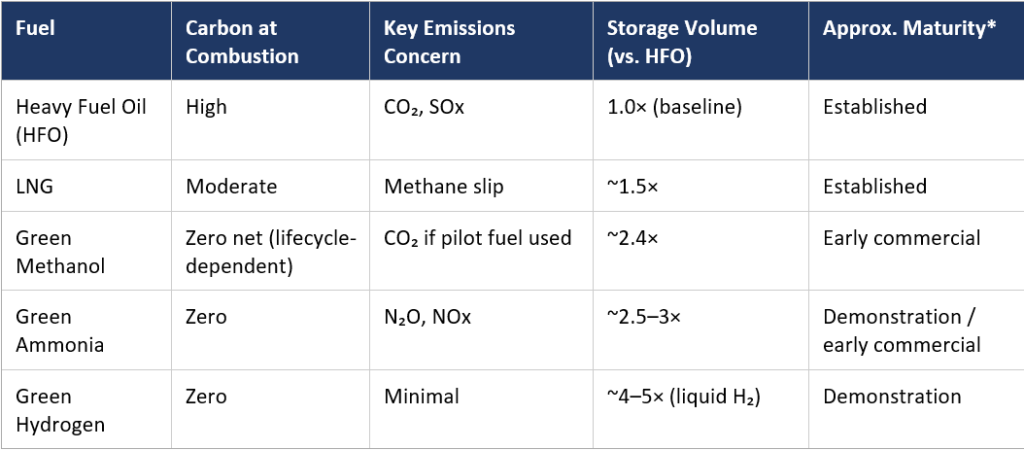
Ammonia’s molecular formula, NH₃, contains no carbon. Combusted in an engine, or processed through a fuel cell, it yields nitrogen and water rather than CO₂ — a property no hydrocarbon-based fuel, including green methanol, fully replicates. This is the central argument for green ammonia marine fuel as a route to zero-emission shipping.
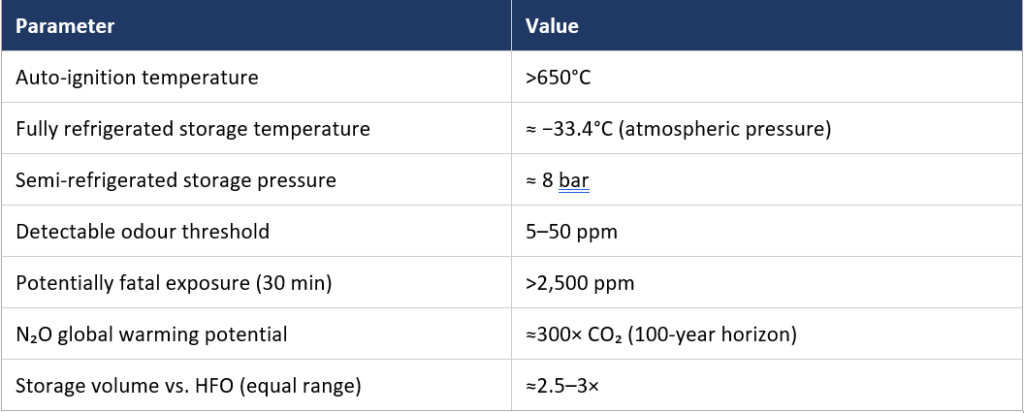
The picture is not entirely clean, however. Combustion can generate Nitrogen Oxides (NOx) and, more significantly, Nitrous Oxide (N₂O) — a greenhouse gas with a global warming potential roughly 300 times that of CO₂ over a 100-year horizon. Marine engineers manage this through precise control of fuel-injection timing and Selective Catalytic Reduction (SCR) units, which inject urea into the exhaust stream to convert NOx into nitrogen gas and water. The underlying technology is well established in land-based power generation; calibrating it to ammonia-specific combustion chemistry is the newer engineering task.
Toxicity and Shipboard Safety
Ammonia’s safety profile is a legitimate constraint on adoption. The gas is corrosive and acutely toxic: its odour is detectable at concentrations as low as 5–50 ppm, yet sustained exposure above 2,500 ppm can be fatal within thirty minutes, with airborne leaks risking chemical burns to the respiratory tract, skin, and eyes.
Vessels carrying ammonia as fuel require layered detection: open-path infrared detectors (Honeywell’s Searchline Excel is one example) for open-deck and bunkering-station monitoring, alongside electrochemical transmitters — such as Dräger’s Polytron 8100 EC — for ppm-level detection in enclosed spaces. Emergency protocols typically mandate gas-tight chemical suits and self-contained breathing apparatus for crew handling leak isolation.
Onboard Storage: Refrigeration and Pressure Configurations
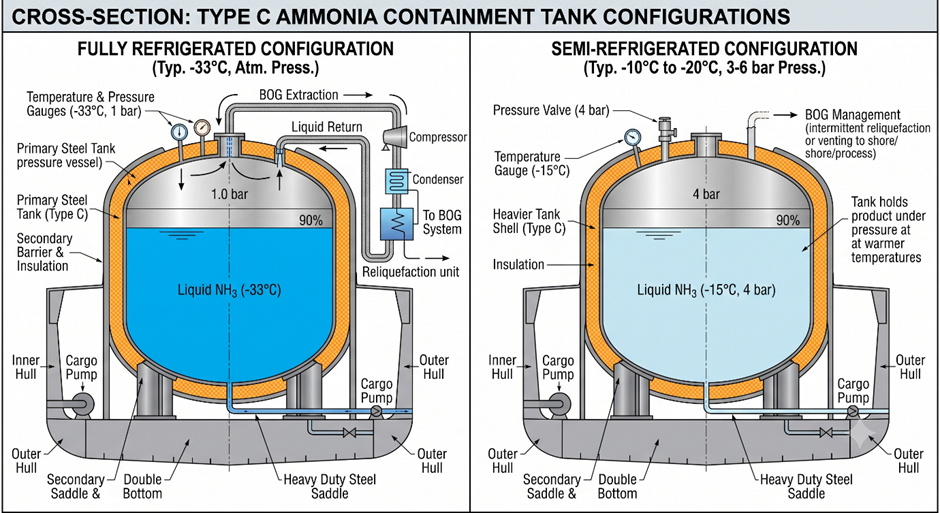
Green ammonia is stored aboard commercial vessels under one of two configurations: fully refrigerated, keeping the fuel liquid at atmospheric pressure at approximately −33.4°C, or semi-refrigerated, holding it under moderate pressure — roughly 8 bar — at somewhat higher temperatures. Both rely on Type C containment tanks, such as the vacuum-insulated cylindrical designs built by TGE Marine Gas Engineering. Neither configuration is trivial to engineer, but both draw on decades of operational precedent from the LPG shipping sector.
Engine Technology: Dual-Fuel Combustion and the Pilot-Fuel Requirement
Ammonia is difficult to ignite under standard compression. Its auto-ignition temperature exceeds 650°C, its flame propagates slowly, and its minimum ignition energy is high relative to conventional marine fuels. Ammonia dual-fuel marine engines address this by injecting a small quantity of a more combustible pilot fuel — typically marine gas oil or biodiesel — to initiate and stabilise combustion. MAN Energy Solutions’ two-stroke LGIA platform and Wärtsilä’s 25 Ammonia engine represent two commercially advanced responses to this design problem, aimed respectively at large ocean-going tonnage and smaller or auxiliary applications.
A parallel, non-combustion pathway is also emerging: Solid Oxide Fuel Cell (SOFC) systems — modules from Alma Clean Power are one example — convert ammonia directly into electricity, while Amogy’s ammonia-to-power system uses an onboard catalytic “cracker” to split ammonia into hydrogen and nitrogen ahead of a fuel cell. Both currently suit auxiliary power more readily than primary propulsion, but represent a complementary line of development.
Energy Density and Operational Trade-Offs
Ammonia’s volumetric energy density is considerably lower than that of HFO. A vessel requires roughly 2.5 to 3 times the fuel storage volume to achieve equivalent sailing range — a constraint that directly reduces available cargo space or requires enlarged tank compartments. This trade-off, more than any single safety or emissions consideration, is arguably the most significant commercial headwind facing widespread adoption.
Material Compatibility and Corrosion Management
Ammonia induces Stress Corrosion Cracking (SCC) in copper, zinc, brass, and certain high-strength carbon steels, ruling out several alloys standard to conventional fuel systems. Fuel lines, valves, and tank fittings must instead use compatible materials — specific stainless-steel grades, or low-strength carbon steels under controlled heat-treatment regimes. Suppliers such as Svanehøj, whose deepwell pumps use ammonia-compatible alloys, illustrate how the supply chain is adapting.
Retrofitting Existing Tonnage versus Newbuild Design
Retrofitting an existing merchant vessel for ammonia fuel is technically feasible but substantially complex, requiring Type A or Type C containment tanks, double-walled fuel piping, upgraded gas-detection and ventilation systems, and conversion or replacement of the main engine block. For most operators the economics favour newbuild designs instead, where tank volume and layout can be planned around ammonia’s storage needs from the outset — one reason DNV, ABS, and Lloyd’s Register have each introduced notations and guidance for ammonia-ready vessel designs.
Regulatory Framework: The IGF Code and Risk-Based Design
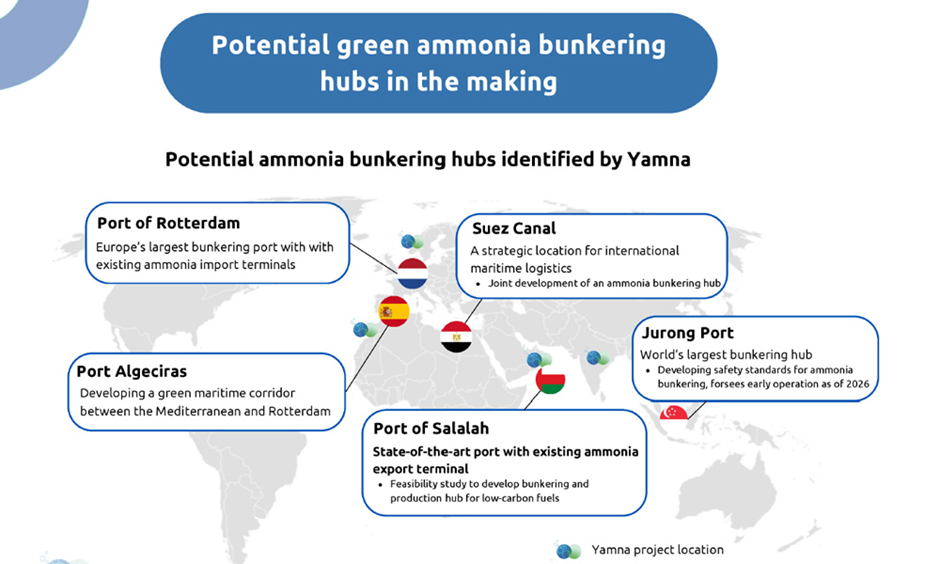
Ammonia as a marine fuel sits outside conventional SOLAS regulation. Installations are instead governed by the International Code of Safety for Ships Using Gases or Other Low-Flashpoint Fuels (IGF Code), via a risk-based design process requiring formal Hazard Identification (HAZID) studies and Computational Fluid Dynamics modelling of vapour-dispersion scenarios — a rigorous, comparatively slow pathway frequently cited as a near-term barrier to scaling deployment. Ammonia bunkering infrastructure faces a parallel challenge, with ship-to-ship transfer safety-zone standards still being formalised, though facilities such as Azane Fuel Solutions’ floating bunkering terminals show commercial infrastructure taking shape around the anticipated framework.
Comparative Fuel Assessment
Quick Reference: Key Technical Parameters
Conclusion and Outlook
Green ammonia is not a frictionless solution. Its toxicity demands rigorous shipboard safety engineering, its energy density imposes real trade-offs against cargo capacity, and its regulatory pathway — built on case-by-case risk assessment rather than settled rules — remains slower than operators would prefer. None of these constraints is trivial, and each deserves equal weight alongside the fuel’s decarbonization potential.
Set against those constraints, however, is a chemistry few competing fuels can match: a genuinely carbon-free molecule, producible at industrial scale from renewable electricity, and backed by a maturing base of dual-fuel engines, containment systems, and classification-society guidance. Whether green ammonia becomes the dominant deep-sea fuel of the mid-century, or one credible option among several, will depend less on the chemistry — already well understood — than on how quickly bunkering infrastructure, regulation, and production capacity scale together. That is the question this field will answer over the next decade.