“The ocean is not just a vast body of water—it is the heartbeat of our planet, the engine of global trade, and the key to a sustainable future.”
When we think about the ocean, we often imagine endless blue waters, sandy beaches, or magnificent marine life. Yet beneath those waves lies one of the world’s greatest economic and environmental assets. Covering more than 70% of the Earth’s surface, the oceans regulate our climate, produce over half of the oxygen we breathe, provide food for billions of people, and carry the overwhelming majority of global trade by volume. Despite their immense importance, the oceans remain underutilized in some areas and overexploited in others.
This is where the concept of the Blue Economy comes into focus. The Blue Economy is not simply about making money from the sea; it is about using ocean resources responsibly to create economic growth, improve livelihoods, and protect marine ecosystems for future generations. It represents a future where development and conservation work together rather than against each other.
Understanding the Blue Economy
The Blue Economy refers to the sustainable use of ocean resources to support economic development while maintaining the health of marine ecosystems. Unlike traditional approaches that prioritize short-term profits, the Blue Economy emphasizes long-term sustainability, innovation, and environmental responsibility.
It brings together industries such as shipping, fisheries, aquaculture, renewable energy, marine biotechnology, coastal tourism, and ocean research under one common goal: ensuring that economic progress does not come at the expense of the oceans.
The Blue Economy recognizes a simple truth—healthy oceans create healthy economies.
Oceans: The Foundation of Global Trade
The maritime industry forms the backbone of international commerce. Every day, thousands of merchant ships transport food, fuel, machinery, medicines, electronics, and countless other goods across oceans. Without shipping, global trade would come to a standstill.
Ports serve as gateways connecting nations, while seafarers work tirelessly to keep supply chains moving. As international trade continues to grow, the maritime sector has an increasingly important role in building a sustainable Blue Economy — cleaner fuels, energy-efficient vessels, digital navigation systems, and smart ports are transforming shipping into a greener and more efficient industry.
Modern container shipping keeps global supply chains moving — but it must decarbonize to remain sustainable.
Table 1 — Global Seaborne Trade at a Glance
| Year | Trade Volume | YoY Growth | Notes |
| 2023 | 12.3 billion tons | +2.4% | Rebound after the 2022 contraction |
| 2024 | 12.72 billion tons | +2.2% | Ton-miles rose 5.9% — fastest since 2011 |
| 2025 (forecast) | ~12.78 billion tons | +0.5% | Slowdown from tariffs and rerouting |
Source: UNCTAD, Review of Maritime Transport 2025
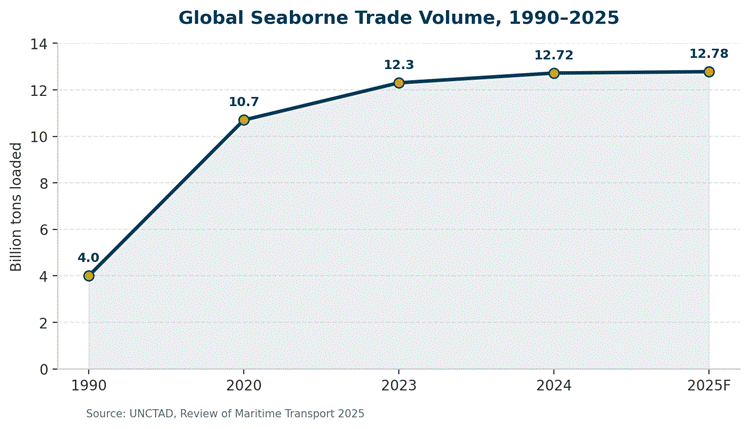
Figure 1 — Global seaborne trade has more than tripled since 1990, though growth has slowed sharply since 2024.
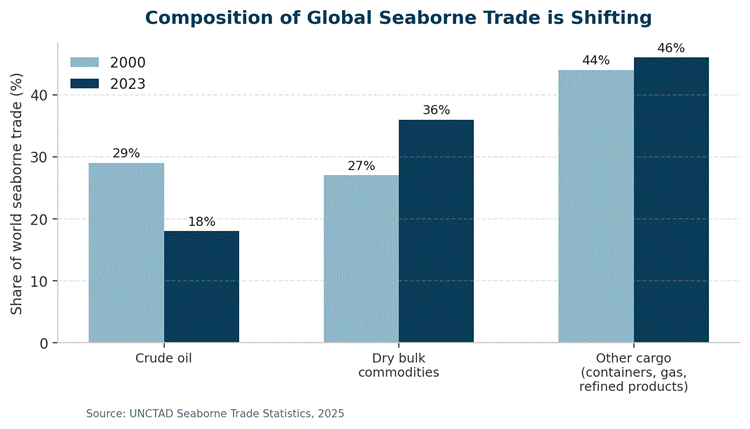
Figure 2 — Dry bulk and containerized goods have steadily displaced crude oil as the dominant seaborne cargo.
Table 2 — 2024 Disruption at a Glance
| Chokepoint / Route | Change vs. Baseline |
| Suez Canal transits (tonnage) | -70% |
| Gulf of Aden transits (tonnage) | -76% |
| Cape of Good Hope arrivals | +89% |
| Panama Canal-affected sailing distance | +31% |
| Average tanker voyage distance (2024) | 5,245 nautical miles |
Source: UNCTAD, Review of Maritime Transport 2024–2025
Sustainable Fisheries: Feeding the World Responsibly
For billions of people, seafood is a major source of nutrition and employment. However, overfishing, illegal fishing, and habitat destruction threaten marine biodiversity and the livelihoods of coastal communities.
The Blue Economy encourages sustainable fishing practices by promoting responsible harvesting, scientific management of fish stocks, and stronger enforcement against illegal activities. Aquaculture, when managed responsibly, also helps meet the growing demand for seafood while reducing pressure on wild fish populations.
Protecting fish today ensures food security tomorrow.
Renewable Energy from the Sea
The ocean offers enormous potential for clean and renewable energy. Offshore wind farms are already supplying electricity to millions of homes around the world. Researchers are also developing technologies to harness wave energy, tidal currents, and ocean thermal energy.
Unlike fossil fuels, these renewable sources produce minimal greenhouse gas emissions and contribute to the fight against climate change. Offshore wind in particular is entering a period of rapid, sustained growth.
Offshore wind turbines are becoming a familiar feature of coastlines worldwide.
Table 3 — Global Offshore Wind Capacity Milestones
| Year | Installed Capacity | Notes |
| 2024 | 83.2 GW | 7.3% of total global wind capacity |
| 2025 | 92.5 GW | +9 GW added; third-highest year on record |
| 2030 (forecast) | 236.3 GW | 24% CAGR projected 2026–2030 |
| 2035 (forecast) | 420 GW | Roughly quadruples the 2025 total |
Source: Global Wind Energy Council, 2026 Global Offshore Wind Report
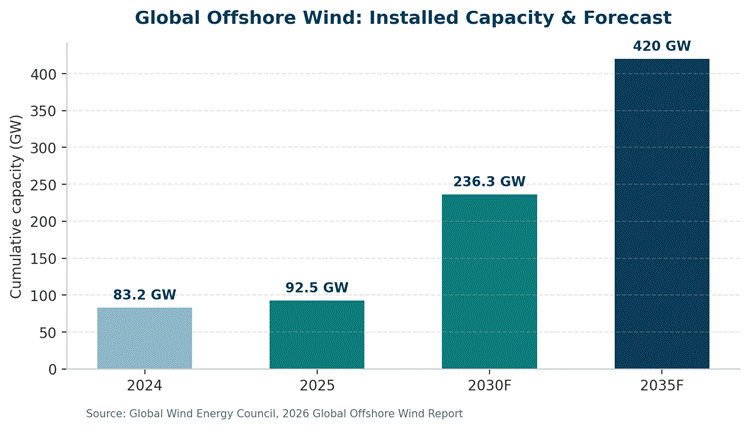
Figure 3 — Offshore wind capacity is forecast to grow more than four-fold by 2035.
As technology advances, marine renewable energy will become an increasingly important pillar of the global energy transition. The sea is not only a highway for trade — it is also a powerful source of sustainable energy.
Marine Biotechnology: Discovering Nature’s Hidden Treasures
Beneath the ocean’s surface exists an incredible diversity of life, much of which remains unexplored. Marine organisms contain unique biological compounds that have the potential to revolutionize medicine, agriculture, cosmetics, and industrial processes.
Scientists have already developed medicines derived from marine organisms to treat diseases such as cancer and chronic pain. Ongoing research may unlock even more breakthroughs in pharmaceuticals, biotechnology, and environmental solutions.
The ocean is often described as the world’s largest natural laboratory, waiting to reveal its secrets.
Coastal Tourism: Economic Growth with Responsibility
Millions of people travel each year to enjoy beaches, coral reefs, islands, and marine wildlife. Coastal and marine tourism generate employment, support local businesses, and contribute significantly to national economies.
However, poorly managed tourism can damage fragile ecosystems through pollution, habitat destruction, and excessive development. Sustainable tourism encourages environmentally responsible practices, including waste reduction, reef conservation, eco-friendly accommodations, and community participation. Tourists become partners in conservation rather than contributors to environmental degradation.
Challenges Facing the Blue Economy
While the opportunities are enormous, the oceans face serious challenges that threaten their future:
- Plastic pollution has reached even the deepest parts of the ocean, harming wildlife and contaminating food chains.
- Climate change is causing rising sea levels, ocean warming, coral bleaching, and stronger storms.
- Illegal, unreported, and unregulated fishing continues to deplete valuable fish stocks.
- Oil spills, chemical pollution, and habitat destruction further damage marine ecosystems.
These challenges remind us that economic growth without environmental responsibility is not sustainable.
Innovation: Driving the Future of the Blue Economy
Technology is reshaping the maritime world like never before. Artificial intelligence helps optimize ship routes, reducing fuel consumption and emissions. Satellite monitoring tracks illegal fishing activities and monitors ocean health. Autonomous underwater vehicles assist scientists in exploring deep-sea ecosystems, while drones inspect offshore infrastructure safely and efficiently.
Smart ports are becoming more energy-efficient through automation, digital logistics, and renewable energy integration. Green fuels such as methanol, ammonia, hydrogen, and biofuels are being explored to reduce the shipping industry’s carbon footprint — but the fleet is still early in this transition.
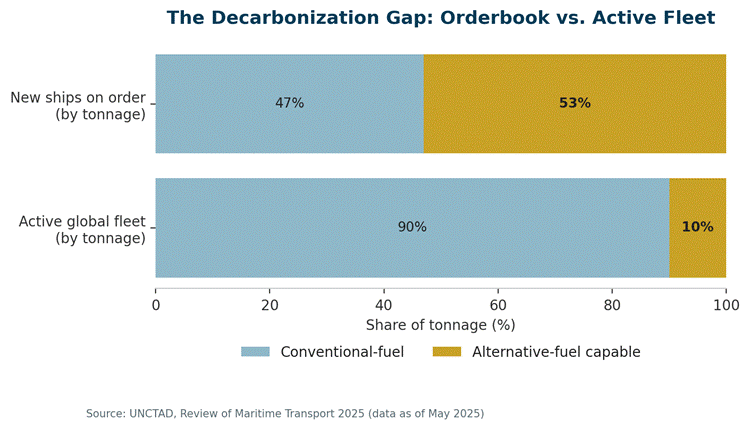
Figure 4 — More than half of new ship orders by tonnage are alternative-fuel capable, but over 90% of the active fleet still runs on conventional fuel.
Table 4 — Decarbonization Investment Needs (Annual, Global)
| Investment Area | Estimated Annual Need |
| New-build / retrofit vessels | US$8–28 billion |
| Onshore refuelling & port infrastructure | US$30–90 billion |
Source: UNCTAD, Review of Maritime Transport 2025
The Role of Young People
The future of the Blue Economy depends on today’s youth. Students, researchers, engineers, entrepreneurs, policymakers, and future seafarers all have important roles to play. Young innovators can develop cleaner technologies, design sustainable vessels, improve marine conservation, and create businesses that protect ocean resources while generating economic opportunities.
Education, environmental awareness, and scientific research will shape the next generation of ocean leaders. For students aspiring to join the maritime industry, the Blue Economy offers not only promising careers but also an opportunity to contribute to global sustainability.
Why the Blue Economy Matters
The Blue Economy is not merely an environmental initiative — it is a blueprint for balancing prosperity with responsibility. Healthy oceans support food security, create employment, regulate climate, preserve biodiversity, and facilitate international trade. Investing in sustainable ocean industries strengthens economies while protecting the natural systems that sustain life on Earth.
Every nation, whether coastal or landlocked, benefits from healthy oceans through trade, climate stability, and global economic interconnectedness.
The ocean’s greatest value lies not in what we can extract from it today, but in what we preserve for tomorrow.
Conclusion
The oceans have always connected civilizations, powered trade, and inspired exploration. Today, they offer humanity another extraordinary opportunity — the chance to build a future where economic growth and environmental stewardship go hand in hand.
The Blue Economy challenges us to rethink our relationship with the sea. It reminds us that the ocean is not an unlimited resource but a shared responsibility. Sustainable shipping, responsible fisheries, renewable energy, marine innovation, and ocean conservation are not separate goals; together, they form the foundation of a resilient and prosperous future.
As future maritime professionals, scientists, policymakers, and global citizens, we have the responsibility to ensure that our oceans remain healthy, productive, and vibrant for generations to come.
The future of our planet will not be written only on land — it will also be shaped by the choices we make at sea. Because when we protect our oceans, we protect our future.