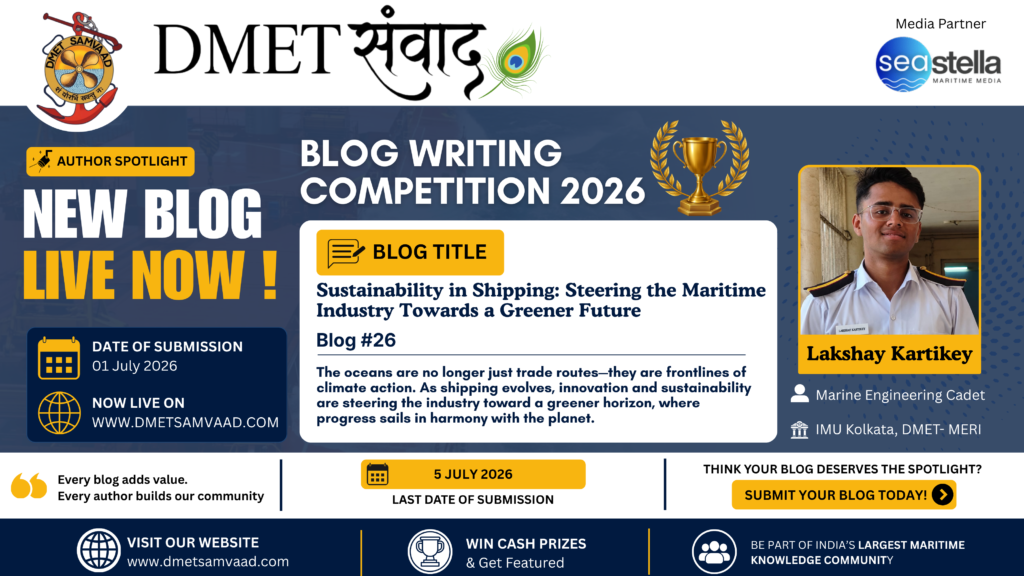
The shipping industry is the backbone of global trade, carrying nearly 90% of the world’s goods across oceans. From food and medicines to automobiles and fuel, almost every product we use has been transported by sea at some stage. While shipping is one of the most efficient modes of transportation in terms of fuel consumed per ton of cargo, it also contributes significantly to global greenhouse gas emissions and marine pollution. As the world moves towards a sustainable future, the maritime industry is undergoing a remarkable transformation. Sustainability in shipping is no longer just an environmental responsibility—it has become a necessity for economic growth, regulatory compliance, and the preservation of marine ecosystems.
First of all we should understand the meaning of Sustainability.
Sustainability in shipping refers to operating vessels in a manner that minimizes environmental impact while ensuring economic viability and social responsibility. It involves reducing carbon emissions, preventing marine pollution, conserving natural resources, improving energy efficiency, and ensuring the welfare of seafarers.
For Example:
Take a look around your room. From the smartphone in your hand to the clothes in your closet and the coffee beans in your kitchen, nearly 80% of everything you own traveled across an ocean to reach you. Maritime shipping is the undisputed backbone of global trade, moving over 11 billion tons of cargo every single year. But this massive logistical web comes with an equally massive environmental footprint. For decades, the global fleet relied on heavy fuel oil (HFO)—a thick, sludge-like byproduct of crude oil refining that releases significant amounts of carbon dioxide, sulfur oxides, and nitrogen oxide into the atmosphere. If the global shipping sector were a country, it would rank among the top ten carbon emitters globally. For years, the maritime industry operated with incremental efficiency gains. However, new global and regional policy frameworks have drastically accelerated the path toward zero-emission shipping. The International Maritime Organization (IMO) has updated its strategy to place a full fuel-system transformation at the center of its vision, moving beyond basic carbon reductions. Two major global mechanisms are driving this transition:
A Global Fuel Intensity Standard: This standard gradually tightens the allowable greenhouse gas (GHG) emissions per unit of energy used on board, forcing a steady shift away from traditional fossil fuels.
A Universal Carbon Pricing System: By penalizing high-emission fuels and closing the financial gap between cheap bunker oil and expensive green alternatives, this economic lever penalizes inaction. Regionally, regulations like Europe’s FuelEU Maritime Regulation are pushing fleets even harder. The policy mandates strict tracking of the energy used on board, applying to all ships above 5,000 gross tonnage calling at EU ports. Crucially, it measures emissions on a full Well-to-Wake (WtW) lifecycle basis—meaning shipowners are held accountable not just for what burns out of the stack, but for how that fuel was produced and transported. Meanwhile, the global fleet must also navigate the Carbon Intensity Indicator (CII) rating system, where underperforming vessels (those receiving D or E ratings) face mandatory corrective action plans to remain legally compliant.Because traditional marine diesel cannot meet these tightening lifecycles, the industry is experimenting with an array of alternative energy sources. There is no single magic bullet; instead, shipbuilders are designing highly flexible, dual-fuel systems capable of adapting to an uncertain supply chain.
Fuel Type
1.Green Methanol
Main Advantages and Key Scaling Bottlenecks: Liquid at ambient temperature; easiest to store and handle with existing infrastructure. Lower energy density than oil; production of truly green e-methanol requires massive renewable energy.
2.Green Ammonia
Main Advantages and Key Scaling Bottlenecks: Completely carbon-free molecule; excellent long-term potential for deep-sea routes. Highly toxic to human health and marine life; requires stringent onboard safety handling protocols.
3.Biofuels & Bio LNG
Main Advantages and Key Scaling Bottlenecks: Can be dropped into existing engines with zero retrofitting costs; immediate emission cuts. Severe global shortages of sustainable biomass; risk of competing with food agriculture.
4.Hydrogen Fuel Cells
Main Advantages and Key Scaling Bottlenecks: Pure zero-emission operation at the point of use; ideal for coastal or short-sea shipping. Extremely low volumetric energy density; requires massive cryogenic storage tanks. While alternative fuels represent the long-term solution, reducing total fuel consumption right now is critical. This urgency has sparked an extraordinary revival of an ancient technology: wind power, reimagined through cutting-edge aerospace engineering.
Modern bulk carriers are increasingly deploying rigid, automated wing sails—often referred to as wind-assisted propulsion systems. Unlike traditional canvas sails, these massive fiberglass and steel structures act like vertical airplane wings. As wind passes around them, they generate forward thrust, taking a massive load off the main engines. On optimal routes, rigid wing sails can slash fuel consumption and emissions by 10% to 20%.
Other physical innovations include:
Air Lubrication Systems: These systems carpet the flat bottom of a ship’s hull with a continuous layer of tiny air bubbles. By reducing the frictional resistance between the hull and the seawater, the vessel can glide through the ocean using significantly less power.
Advanced Silicon Hull Coatings: High-tech, non-toxic coatings prevent marine organisms (like barnacles and algae) from anchoring to the ship. This prevents “biofouling,” which can degrade a vessel’s aerodynamic efficiency and spike fuel consumption by up to 30%.
These retrofits are vital given that the average age of the global merchant fleet is roughly 22.5 years. Shipowners cannot simply scrap every older vessel; instead, they must implement strategic aerodynamic and mechanical upgrades to keep their existing assets compliant under modern environmental laws.
Smarter Sailing Through AI and Data:
The final piece of the sustainability puzzle isn’t found on the deck or in the fuel tank—it resides in the software. The maritime sector is undergoing a rapid digital transformation, turning vast pools of raw voyage data into real-time operational intelligence. AI-driven voyage optimization platforms now analyze real-time weather forecasts, ocean currents, wave heights, and port congestion. By processing these variables, the software calculates the most efficient route and recommends the exact propeller revolutions per minute (RPM) required. Rather than rushing across the ocean only to sit idle outside a congested port burning fuel, ships use “just-in-time” arrivals, slowing down to conserve fuel and arriving precisely when their berth opens up. This operational practice, combined with “slow steaming” (deliberately reducing transit speeds), delivers immediate, double-digit emissions reductions without requiring a single dollar of hardware modification.
At Last The transition to truly sustainable shipping is a monumental task. Clean fuels remain significantly more expensive than heavy bunker oil, and the global infrastructure required to safely store and distribute green hydrogen or ammonia at thousands of ports is still in its infancy. Over 85 global maritime leaders—ranging from ports and fuel producers to shipowners—have issued unified calls for governments to finalize global net-zero economic frameworks to remove the financial risk from these massive investments. Despite these hurdles, the trajectory is irreversible. As global supply chains face scrutiny from climate-conscious consumers and strict regulatory bodies, green shipping has transformed from an experimental ideal into a commercial necessity. The maritime industry is officially leaving its fossil-fueled past behind, charting a definitive course toward a cleaner, smarter, and genuinely sustainable future on the high seas.
~ Cadet Lakshay Kartikey